
Seeing "WL 47" or "RLWL 12" next to your ticket can feel like a coin toss, but it isn't random at all — waiting list movement follows fairly predictable patterns once you understand what type of waiting list you're actually on.
What a waiting list ticket actually means
A waiting list ticket means all confirmed and RAC berths were already booked when you made your reservation. You have a valid ticket and a position in a queue — as other passengers cancel their confirmed or RAC tickets, waiting list positions move up, potentially confirming before the chart is prepared.
The different types of waiting lists
| Type | Meaning | Typical movement |
|---|---|---|
| GNWL | General Waiting List — for journeys starting from the train's origin station | Usually clears reasonably well on most routes |
| RLWL | Remote Location Waiting List — for a specific intermediate station's quota | Can clear more slowly, depends heavily on that station's quota size |
| PQWL | Pooled Quota Waiting List — shared between certain stations along the route | Movement varies significantly by route |
Same-looking number, very different odds
A GNWL of 15 and an RLWL of 15 can have completely different confirmation chances, even though the number looks identical. The waiting list type matters as much as the number itself.
What RAC actually means
RAC — Reservation Against Cancellation — means you're guaranteed to travel, but may initially share a berth with another RAC passenger rather than having a full berth to yourself. If a confirmed passenger cancels before departure, RAC passengers can be upgraded to a full confirmed berth, following priority order.
You book RAC 3 for an overnight journey. By chart preparation, two confirmed passengers cancel. As an RAC ticket holder, you may be upgraded to a full confirmed berth — but even if you're not, you're still guaranteed a seat and can travel.
When does the waiting list actually clear?
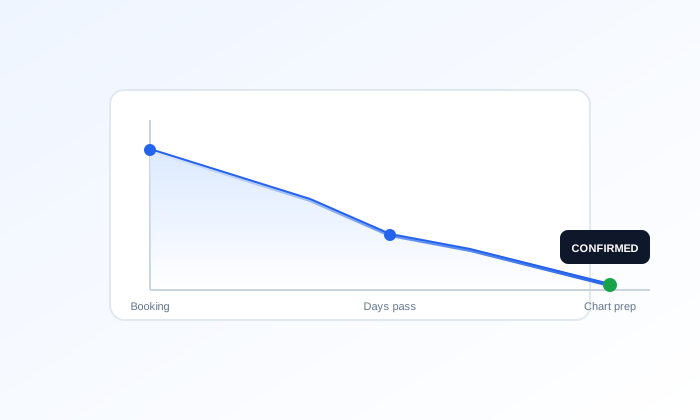
Most waiting list movement happens gradually as people cancel in the days and hours leading up to departure, with a final flurry right around chart preparation — typically a few hours before the train departs. If your ticket hasn't confirmed by then, it generally won't confirm at all, and depending on the ticket type, may be eligible for a refund since you can't board with an unconfirmed waiting list ticket.
How to judge your realistic chances
- Check the waiting list type (GNWL, RLWL, PQWL) — not just the number.
- Look at how many days remain before departure — more time generally means more chances for cancellations to clear your position.
- Consider the route's typical demand — a route with heavy business travel might see more last-minute cancellations than a route with mostly leisure travel.
- Don't assume a low waiting list number is automatically safe, or a high number automatically hopeless — context matters more than the raw figure.
Backup plans if your ticket doesn't confirm
If you're genuinely worried about a waiting list ticket clearing, it's worth having a backup: check an alternate train, consider Tatkal closer to the date if it's still available and worthwhile, or explore a different route entirely. Waiting until the last moment to figure out a backup plan, right as chart preparation approaches, leaves you with far fewer options than considering it a week or two ahead.
Common mistakes
- Assuming all waiting list types behave the same way.
- Not checking waiting list movement in the days leading up to travel.
- Waiting until the last minute to arrange a backup plan.
- Confusing RAC with a fully confirmed, unshared berth.
Quick summary
- Booking opens 60 days before your journey date under the General quota, at 8:00 AM.
- Tatkal and Premium Tatkal open one day before travel, with separate timings for AC and Non-AC classes.
- Rules can change — always confirm close to your travel date on the official IRCTC platform.
Frequently Asked Questions
Know your exact booking date
Enter your journey date and get the precise Advance Reservation Period opening — in under 3 seconds.
Calculate Your Booking Date