
If you travel by train more than once or twice a year, thinking about booking dates one trip at a time is a losing strategy. A simple monthly planning habit — treating your booking calendar the way you'd treat a bill due date — removes almost all of the stress.
Why a calendar beats remembering dates
Booking dates don't feel urgent until suddenly they are. The trip is two months away, it doesn't feel pressing, and then one day you realize the window opened last week. A calendar-based approach fixes this by turning an abstract future date into a concrete entry you'll actually see.
A simple monthly habit
Once a month, sit down for five minutes and think through any travel you already know is coming in the next 60-90 days — family events, work trips, festivals. For each one, calculate the booking date and add it to your calendar immediately, rather than trying to remember it later.
On the first of each month, you review what's coming up: a cousin's wedding in 10 weeks, a work conference in 8 weeks, a possible festival trip home. You calculate each booking date right then, using a calculator, and add all three to your calendar in one sitting.
Using a visual booking calendar
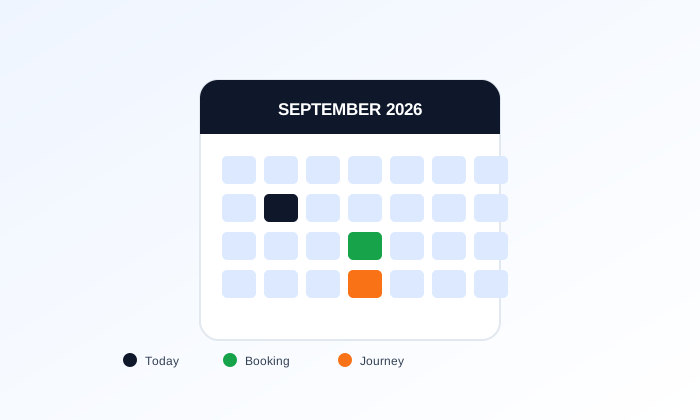
A visual monthly calendar — like the one built into our homepage calculator — makes it much easier to see today's date, your booking date, and your journey date all at once, rather than juggling three separate numbers in your head. Seeing the actual gap between "today" and "booking day" on a real calendar grid tends to make the timeline feel more concrete than a countdown number alone.
Managing multiple upcoming trips at once
If you're planning several trips across the next few months, it helps to list them out together rather than one at a time:
| Trip | Journey date | Booking date |
|---|---|---|
| Wedding | 15 September | 17 July |
| Work conference | 2 October | 3 August |
| Festival visit home | 6 November | 7 September |
Seeing them side by side makes it obvious which booking date is coming up soonest, so nothing catches you off guard.
Digital calendar or physical planner?
Either works, as long as you'll actually look at it. A phone calendar with notifications has the advantage of pushing the reminder to you rather than requiring you to remember to check. A physical planner works well for people who review it daily as a habit already. The best system is whichever one you'll consistently use — not necessarily the most feature-rich one.
Combine a calendar entry with an actual reminder
A calendar entry you have to remember to check isn't much better than no reminder at all. Pair it with a notification, alarm, or our ICS download and Google Calendar integration so it actively reaches you.
Common planning mistakes
- Only thinking about booking dates one trip at a time, right before each one.
- Relying on memory instead of writing the date down anywhere.
- Adding a calendar entry without an actual notification or alarm attached.
- Not revisiting the calendar regularly enough to catch new trips as they come up.
Quick summary
- Booking opens 60 days before your journey date under the General quota, at 8:00 AM.
- Tatkal and Premium Tatkal open one day before travel, with separate timings for AC and Non-AC classes.
- Rules can change — always confirm close to your travel date on the official IRCTC platform.
Frequently Asked Questions
Know your exact booking date
Enter your journey date and get the precise Advance Reservation Period opening — in under 3 seconds.
Calculate Your Booking Date